
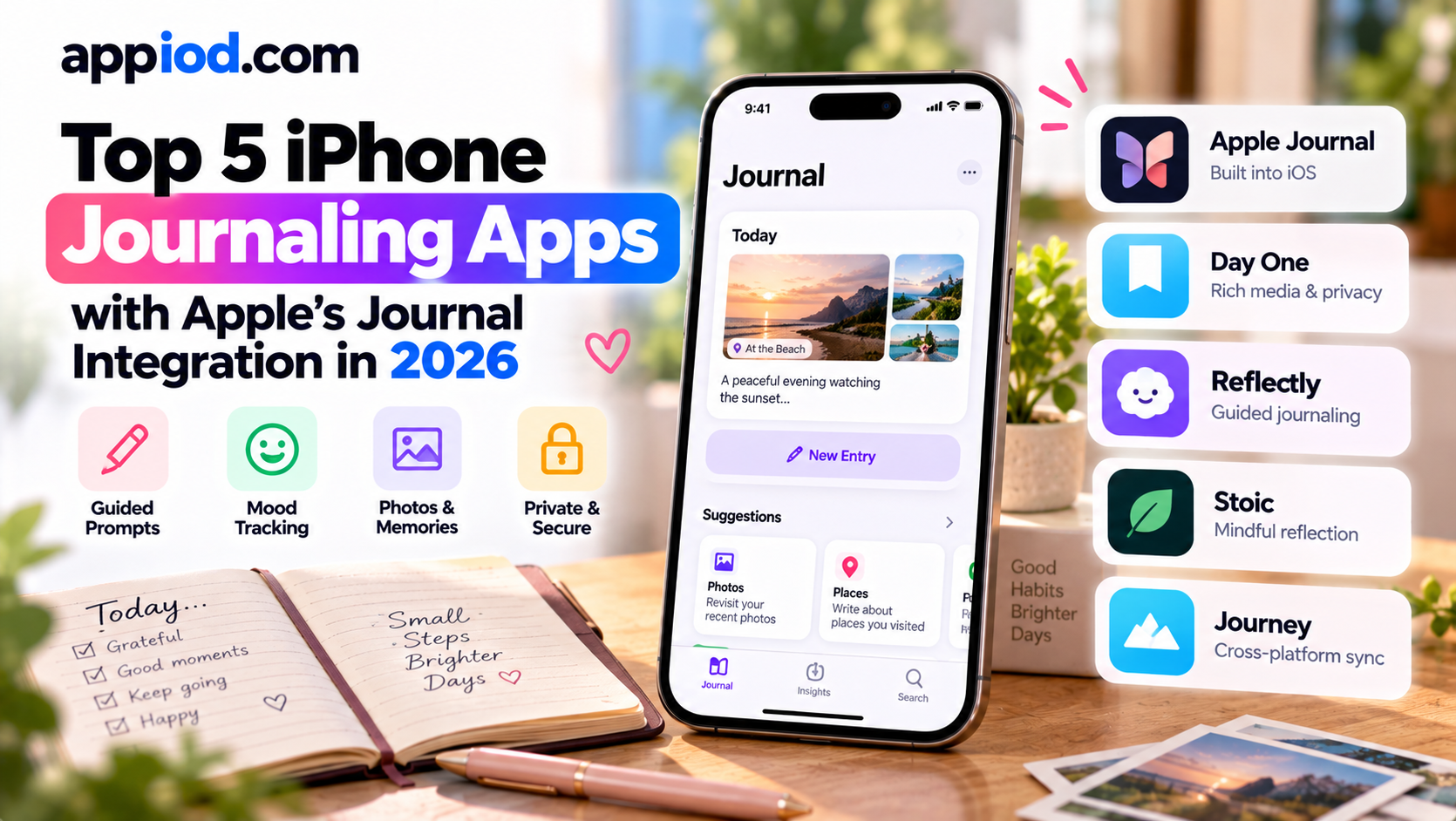
Apple’s own native Journal app, built directly into iOS, covers the basics of daily reflection genuinely well, automatically suggesting relevant photos and moments from a person’s day as writing prompts. A mature ecosystem of third-party journaling apps has grown up specifically to extend that foundation with deeper guided prompts, genuine mood tracking, and richer long-term reflection tools that Apple’s native app doesn’t attempt. Here’s a look at what’s worth using this year.
Apple Journal
Apple’s native Journal app remains the natural starting point for most iPhone users, automatically surfacing relevant photos, locations, workouts, and other daily moments as genuinely personalized writing prompts rather than requiring a user to remember what happened each day unassisted. Its tight system integration means journaling suggestions appear automatically based on real device activity throughout the day, and its on-device processing keeps entries genuinely private without any cloud dependency required. For most users who want a simple, free, deeply integrated journaling habit without a separate app, it remains the sensible default starting point.
Day One
Day One remains one of the most polished, feature-complete journaling apps available, offering genuinely rich media support, letting users embed photos, audio recordings, and location data directly within an entry, alongside end-to-end encryption for users who want genuine privacy assurance beyond Apple’s own on-device processing. Its multiple journal feature lets users maintain separate journals for different areas of life, personal reflection, travel, gratitude, without mixing entries together in one undifferentiated stream. For users who want the deepest, most feature-rich journaling experience with genuine long-term archival quality, it remains one of the most respected apps in the entire category.

Reflectly
Reflectly takes a genuinely guided, conversational approach to journaling, using an AI-style chat interface that asks specific questions about a person’s day and mood rather than presenting a blank page, particularly helpful for anyone who finds open-ended journaling genuinely difficult to start. Its mood tracking builds a visual history over time, letting users spot genuine patterns in emotional wellbeing that a purely text-based journal might not surface as clearly. For users who want structured guidance and genuine mood pattern tracking rather than free-form writing, it remains one of the more approachable, guided options available.

Stoic
Stoic focuses specifically on journaling grounded in Stoic philosophy, offering structured morning and evening prompts drawn from Stoic principles alongside genuine mood and gratitude tracking woven into that same philosophical framework. Its distinctive philosophical angle appeals specifically to users who want their journaling practice tied to a genuine, coherent framework for thinking about daily challenges rather than open-ended, unstructured reflection alone. For users specifically drawn to Stoic philosophy or wanting a more structured, principle-based approach to daily reflection, it remains a genuinely distinctive option in the category.
Journey
Journey offers a genuinely clean, cross-platform journaling experience with automatic weather, location, and step count logging alongside each entry, building a rich, automatically contextualized record of daily life without requiring extensive manual data entry. Its cross-platform sync across iOS, Android, and web gives users genuine flexibility to journal from whatever device happens to be at hand, rather than being locked into a single Apple-only ecosystem. For users who want their journaling practice to genuinely follow them across multiple devices and platforms, it remains one of the more flexible options available.
Choosing between these five comes down mostly to how much structure and additional feature depth is actually wanted beyond Apple’s already-capable native Journal app. Most users should start with Apple Journal’s free, deeply integrated foundation, while anyone wanting the richest media support and genuine long-term archival depth should upgrade to Day One. Users who find open-ended journaling genuinely difficult to start should consider Reflectly’s guided, conversational prompts, anyone drawn to a specific philosophical framework should explore Stoic’s principle-based approach, and users needing genuine cross-platform flexibility beyond Apple’s ecosystem should choose Journey instead.
Conclusion
A consistent journaling habit remains one of the more genuinely accessible tools for daily reflection and emotional processing, and 2026’s strongest iPhone apps have gotten skilled at removing the friction that keeps many people from actually sticking with the practice. Whichever of these five ends up fitting a specific reflection style, the underlying payoff remains the same: a daily habit of genuine reflection that actually gets sustained, rather than abandoned after a promising first week.