
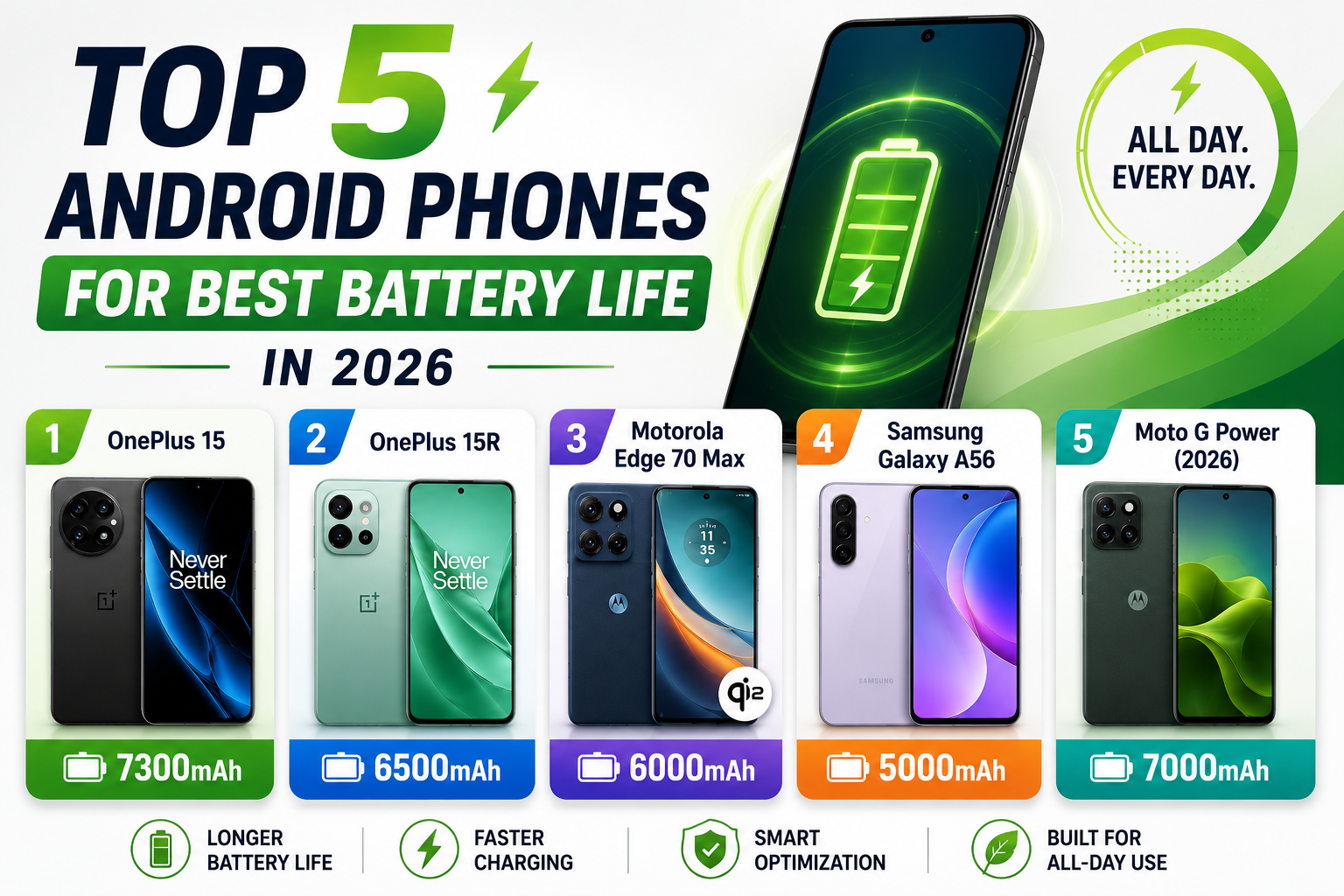
Battery anxiety, once one of the strongest arguments for switching away from Android, has become close to a non-issue in 2026 thanks to a broader industry shift toward silicon-carbon battery cells, which pack meaningfully more capacity into the same physical footprint as older lithium-ion designs. Phones that would have seemed impossible just a few years ago, six and seven thousand milliamp-hour batteries in devices that don’t feel like bricks, have become genuinely common across both flagship and budget tiers this year. Whether the priority is a true multi-day flagship or a budget phone that simply refuses to die by mid-afternoon, here are five Android phones actually delivering on battery life in real-world testing this year.
OnePlus 15
The OnePlus 15 has emerged as the clear battery-life benchmark of 2026, posting the longest real-world test times of any phone tracked by major outlets this year thanks to its large silicon-carbon battery paired with genuinely efficient software optimization. It comfortably handles a full day of heavy use, video streaming, gaming, and navigation included, with meaningful charge left over, and its fast wired charging means even a quick top-up between meetings restores a substantial chunk of capacity. For anyone who wants flagship performance without ever needing to think about battery management throughout the day, it’s the current standard the rest of the category is being measured against.
OnePlus 15R
The OnePlus 15R brings nearly the same exceptional battery performance as its flagship sibling at a meaningfully lower price point, trading some camera and processing headroom for a device that still comfortably outlasts nearly every competitor on the market. It’s a strong pick for anyone who wants OnePlus’s battery engineering without paying full flagship pricing, and its fast charging remains largely intact from the standard model, so topping up quickly is still an option even on the more affordable tier.
Motorola Edge 70 Max
Motorola’s Edge 70 Max pairs a large silicon-carbon battery with genuinely fast 90-watt wired charging and 25-watt Qi2 magnetic wireless charging, making it one of the only Android phones to match Apple’s MagSafe-style magnetic charging convenience while also delivering serious all-day endurance. Motorola has quietly built a strong reputation for battery engineering across its lineup, and the Edge 70 Max represents the company pushing that strength further up toward genuine flagship territory rather than keeping it confined to budget devices.
Samsung Galaxy A56
The Samsung Galaxy A56 proves that excellent battery life doesn’t require flagship pricing, pairing a 5,000mAh battery with an efficient Exynos 1580 chip that regularly delivers 9 to 11 hours of real screen-on time in everyday use, ahead of some phones costing nearly twice as much. It ships with Android and six years of promised OS updates, a genuinely long support window for a mid-range device, and its 6.7-inch adaptive 120Hz display doesn’t come at the cost of the all-day battery performance that has made it one of the strongest value arguments in Samsung’s entire lineup this year.
Motorola Moto G Power (2026)
The Moto G Power (2026) rounds out the list as the strongest pure budget pick, delivering battery test times that rival or beat several flagship phones despite its considerably lower price point. Its lithium-ion battery, rather than the newer silicon-carbon cells found in pricier phones, still manages exceptional endurance through efficient hardware and software tuning, proving that battery longevity doesn’t strictly require the latest cell chemistry when the rest of the phone is tuned well around it. For anyone who wants a genuinely reliable all-day phone without spending flagship money, it remains one of the smartest budget picks in Motorola’s lineup.
This year’s lineup makes clear that exceptional battery life is no longer confined to a single price tier; the gap between what a flagship and a genuinely well-tuned budget phone can deliver on a single charge has narrowed considerably. Buyers chasing the absolute longest real-world endurance without compromise should look to the OnePlus 15, while anyone wanting nearly the same performance for meaningfully less money should strongly consider the OnePlus 15R. Motorola’s Edge 70 Max stands out specifically for anyone who also wants Qi2 magnetic charging convenience, and both Samsung’s Galaxy A56 and Motorola’s Moto G Power (2026) prove that all-day battery confidence is achievable well outside flagship pricing this year.
Conclusion
Battery life has stopped being the compromise it once was across nearly every price tier of the Android market, and 2026’s silicon-carbon-driven lineup reflects a genuine industry-wide shift rather than a single manufacturer’s temporary edge. Whether the budget allows for a true flagship or a genuinely capable mid-ranger, this year’s top five phones each prove that dying by mid-afternoon is no longer something Android users need to plan around.