
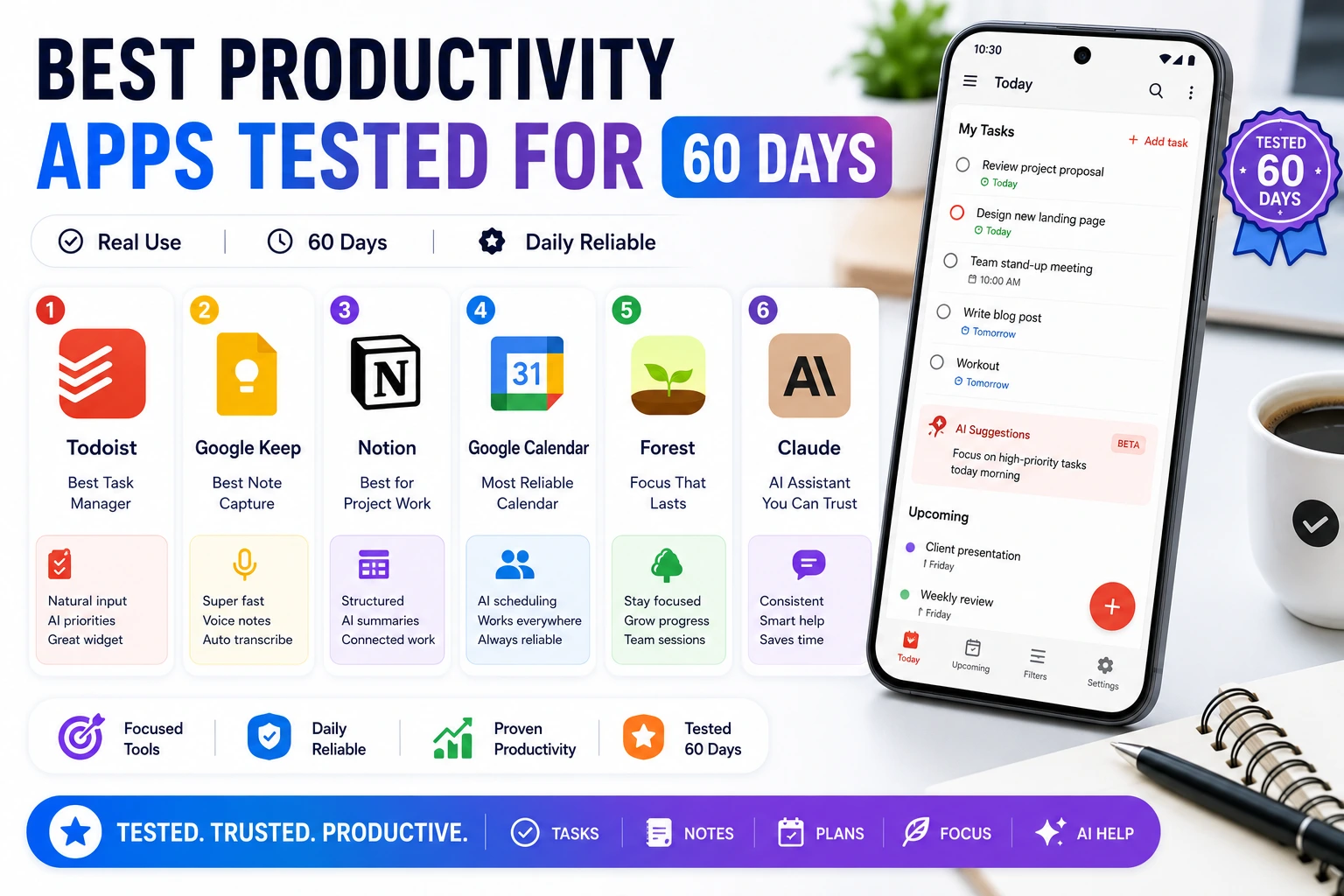
Most productivity app reviews evaluate features in isolation – what does the app do, how does the interface look, what does the marketing page promise. This review takes a different approach: every app here was used as the primary tool for its category across sixty days of genuine daily professional work, with the goal of identifying which apps actually deliver sustained value once the initial novelty wears off and the real test of daily reliability begins.
Todoist – Best Task Manager for Sustained Daily Use
After sixty days of using Todoist as the primary task management system, the feature that proved most durable was the natural language input – typing a task with a date and recurring pattern in plain language continued to feel fast and frictionless even after the novelty of the feature wore off in the first week. This matters because task management tools succeed or fail based on whether capturing a task takes under five seconds; anything longer creates enough friction that tasks simply do not get captured.
The Android widget implementation is genuinely excellent – a home screen widget showing today’s tasks with one-tap completion meant checking off tasks did not require opening the full app for most quick interactions. The AI-suggested due dates and priorities, while a 2026 addition that initially seemed like a minor feature, became genuinely useful by week three as the suggestions improved based on observed patterns in personal task completion behaviour.

Google Keep – Best Note Capture for Sustained Daily Use
For pure quick capture – the kind of note-taking that happens dozens of times per day for fleeting thoughts, shopping list items, and quick reminders – Google Keep’s speed and simplicity held up better over sixty days than more feature-rich alternatives that were tested in parallel. The lack of friction in opening the app, typing a note, and closing it again meant Keep became the genuine default capture tool rather than a tool that got bypassed in favour of just remembering things mentally and frequently forgetting them.
The voice note transcription feature proved unexpectedly valuable during the test period, particularly while walking or driving when typing was not practical. The automatic transcription accuracy was reliable enough that voice notes became a frequently used capture method rather than a novelty feature used once and abandoned.
Notion – Best for Structured Project Work Over Time
Notion’s value proposition becomes clearer over an extended testing period rather than diminishing. In the first week, the flexibility felt like unnecessary complexity for simple tasks. By week eight, the accumulated structure – linked databases connecting project pages to tasks to meeting notes – had become a genuinely valuable knowledge system that quick-capture tools like Keep cannot replicate.
The AI features, tested specifically for sustained value rather than impressive first impressions, proved their worth most clearly in the page summarisation feature when returning to old project documentation after a period of being focused elsewhere. Being able to quickly get back up to speed on a project’s status without re-reading every page saved measurable time repeatedly throughout the test period.
Google Calendar – Most Reliable Calendar for Daily Use
While third-party calendar apps offer more sophisticated features, Google Calendar’s reliability and broad compatibility proved to be the most durable advantage over sixty days of testing. Every meeting invitation, every calendar share with colleagues, and every integration with other work tools worked without friction precisely because Google Calendar is the universal standard that other tools build around.
The 2026 AI scheduling suggestions – automatically proposing meeting times based on all attendees’ existing calendar availability – genuinely reduced the back-and-forth typically required to schedule meetings with multiple participants, a feature that proved valuable consistently rather than just impressively in initial testing.
Forest – Focus Discipline That Held Up Over Time
The risk with gamified focus apps is that the novelty of the mechanic wears off and the discipline reverts to baseline. Across sixty days of testing, Forest’s tree-growing mechanic retained its motivational effect better than expected, particularly because the visual record of accumulated focus sessions over weeks created a sense of progress that pure willpower-based discipline does not provide.
The team focus session feature, used occasionally with a colleague also testing the app, added a social accountability dimension that improved consistency on days when individual motivation was lower than usual.
Claude – AI Assistant That Earned Continued Trust
Across sixty days of using Claude for writing assistance, research synthesis, and problem-solving support, the quality consistency proved to be the most valuable characteristic – rather than occasionally impressive and occasionally frustrating output, Claude’s responses remained reliably useful across the full testing period, building genuine trust in its output that made it a default tool rather than an occasional novelty.
The Pattern Across Sixty Days of Real Use
The clearest lesson from this extended testing approach is that the apps which held up best over sixty days were not necessarily the ones with the most impressive feature lists, but the ones with the most consistent reliability and the lowest friction for their core use case. Flashy AI features and extensive customisation options matter less for sustained productivity than simply working reliably every single time you need them, without requiring conscious effort to remember how to use them.
Building Your Tested Productivity Stack
Based on this extended real-world testing, the combination of Todoist for tasks, Google Keep for quick capture, Notion for structured project work, Google Calendar for scheduling, and Claude for AI assistance represents a productivity stack validated by genuine sustained daily use rather than first-impression feature comparison. Each app earned its place specifically by remaining useful after the initial novelty period ended.